Solving the Noise Problem: Acoustic Solutions for Open Offices
Austin Frantell · 7 min read · March 17, 2026
The number one complaint in open office environments isn't the lack of privacy, the temperature, or the lighting. It's noise. Study after study confirms what anyone who's worked in an open plan already knows: unwanted noise destroys concentration, increases stress, and tanks productivity.
The good news is that acoustics in open offices are a solvable problem. The bad news is that there's no single magic fix — effective acoustic treatment requires a combination of strategies across furniture, architecture, and technology. Here's what actually works.
Understanding the Basics: NRC and STC
Before evaluating products, it helps to understand two key acoustic ratings.
NRC (Noise Reduction Coefficient) measures how much sound a material absorbs on a scale of 0 to 1. An NRC of 0 means the material reflects all sound (like glass or concrete). An NRC of 0.85 means it absorbs 85% of the sound that hits it. For office acoustic panels, look for products with an NRC of 0.70 or higher to make a meaningful difference.
STC (Sound Transmission Class) measures how much sound a barrier blocks from passing through it. This is the relevant rating for walls, partitions, and enclosed spaces. A standard drywall office wall rates around STC 35-40. An STC of 50+ provides genuine speech privacy — you can hear voices but can't make out words.
The key distinction: NRC tells you how much sound a surface absorbs (reducing echo and reverberation). STC tells you how much sound a barrier blocks (providing privacy between spaces). Open office acoustics require both absorption and strategic blocking.
Panel Height and Acoustics
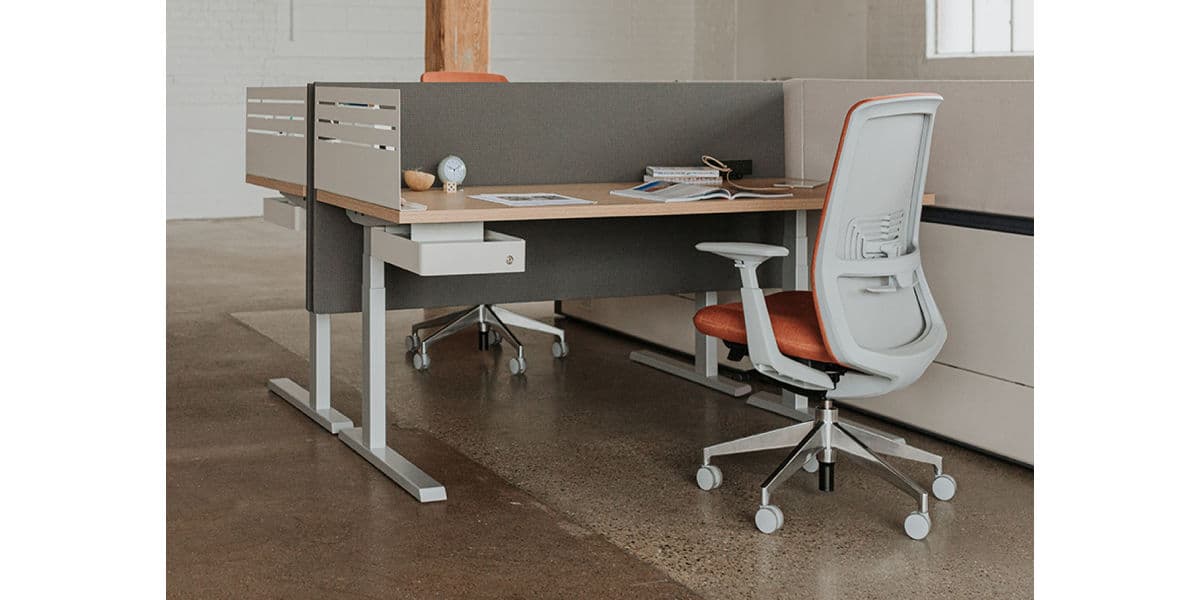
If you're using workstation panels or screens, their height directly affects acoustic performance.
- 42" panels: Provide visual separation but minimal acoustic benefit. Sound travels easily over the top. This height is common in modern open plans prioritizing collaboration and sightlines.
- 54" panels: The sweet spot for many offices. Provides meaningful sound reduction for seated workers while still allowing some visual connection. Reduces direct sound transmission between adjacent workstations by roughly 40-50%.
- 65"+ panels: Significant acoustic separation. Creates a more enclosed feel — effective for noise but can feel like a cubicle farm. Increasingly uncommon in modern office design.
Panel fabric matters too. Acoustically rated panel fabric with an NRC of 0.65+ absorbs sound that hits the panel surface. Standard fabric or hard-surface panels reflect sound, reducing their acoustic value even at useful heights.
If you're planning a workspace layout, panel height is one of the most consequential acoustic decisions you'll make.
Acoustic Pods and Phone Booths
The most visible trend in open office acoustics is the standalone acoustic pod — a self-contained, enclosed unit placed on the open floor that provides a private space for calls, video meetings, and focused work.
What they offer:
- STC ratings of 30-35 (enough to prevent speech intelligibility from outside)
- Integrated ventilation, lighting, and power
- One-person phone booths, two-person meeting pods, and four-person small meeting rooms
- No construction required — they're freestanding and relocatable
Major brands: Framery, ROOM, Zenbooth, Cubicall, and several others have entered this market.
Pricing:
- Single-person phone booth: $5,000-$9,000
- Two-person meeting pod: $8,000-$15,000
- Four-person meeting pod: $12,000-$25,000
These aren't cheap, but compare the cost to building a traditional enclosed phone room or huddle room — which involves construction, permitting, HVAC modifications, and permanent commitment of floor space. Pods are increasingly cost-competitive, especially for tenants who can't or don't want to modify their space.
Important considerations:
- Ventilation. Cheap pods get stuffy fast. Look for active ventilation systems, not just passive airflow.
- Size. Some one-person booths are claustrophobically small. Test before you buy, especially if your team will use them for extended video calls.
- Fire code compliance. Verify that the pod meets your local fire code requirements. Some jurisdictions have specific rules about enclosed spaces without sprinklers.
- Acoustics from inside. The pod should block outside noise from entering, not just prevent inside noise from escaping.
Desk-Mounted Acoustic Screens
For a lower-cost intervention, desk-mounted acoustic screens attach directly to the worksurface and provide localized sound absorption and partial blocking.
Types:
- Fabric-wrapped acoustic panels that clamp to the desk edge — NRC 0.70-0.85
- PET felt screens (made from recycled plastic bottles) — lightweight, modern aesthetic, NRC 0.50-0.70
- Frosted acrylic screens — visual privacy but minimal acoustic benefit (hard surfaces reflect sound)
Cost: $100-$400 per screen depending on material and size.
Desk screens won't transform a noisy open office on their own, but they reduce direct sound transmission between adjacent workstations and provide a psychological sense of personal space. They're most effective when combined with ceiling treatment and sound masking.
Ceiling Treatments
The ceiling is the largest untreated reflective surface in most offices, and it's often where the biggest acoustic gains are available.
Standard acoustic ceiling tile (like Armstrong or USG products) with an NRC of 0.55-0.70 is a baseline. If your office has exposed ceilings (painted deck, exposed ductwork) — common in modern creative offices — you're missing this entire absorption layer, and the space will be noticeably louder.
Ceiling baffles and clouds are suspended acoustic panels hung from the ceiling structure. They work well in spaces with exposed ceilings where traditional ceiling tile isn't appropriate:
- Baffles hang vertically in rows, providing absorption on both sides
- Clouds are horizontal panels suspended below the deck, acting like floating ceiling segments
Cost: $8-$20 per square foot for ceiling baffles or clouds, installed. It's a meaningful investment, but for spaces with exposed ceilings and significant noise complaints, it's often the single most impactful treatment.
Flooring: Carpet vs. Hard Surface
Flooring choice has a surprisingly large impact on office acoustics.
Carpet tile (the standard commercial flooring for office spaces) provides meaningful sound absorption, particularly for impact noise (footsteps, dropped items, rolling chairs). A quality carpet tile with cushion backing can achieve an NRC of 0.25-0.35 — not high in isolation, but covering thousands of square feet, it adds up.
Hard flooring (LVT, polished concrete, hardwood) reflects sound and amplifies impact noise. Hard floors look great but make open offices measurably louder. If you're committed to hard flooring for aesthetic reasons, budget for additional acoustic treatment elsewhere — more ceiling absorption, more panel fabric, and potentially sound masking.
Area rugs in collaboration zones and common areas can partially mitigate hard-floor acoustics in targeted locations.
Sound Masking Systems
Sound masking is the most misunderstood acoustic solution — and often the most effective.
What it is: A system of speakers (typically installed above the ceiling) that emits a carefully engineered, continuous background sound. It sounds like soft airflow — most people don't notice it after a few minutes.
What it does: It raises the ambient background noise level just enough that nearby conversations become unintelligible. You can still hear that someone is talking, but you can't make out the words. This dramatically reduces the distraction of overheard conversations, which is the primary noise complaint in open offices.
What it isn't: It's not noise cancellation (that's a headphone technology). It's not white noise (white noise is harsh and fatiguing). Modern sound masking is precisely tuned to the frequency range of human speech.
Major systems: Cambridge Sound Management (QtPro), Lencore, Atlas Sound.
Cost: $1.50-$3.00 per square foot, installed. For a 20,000 SF office, that's $30,000-$60,000 — significant, but it treats the entire space uniformly, which no other single solution can claim.
Sound masking is particularly effective in combination with moderate panel heights (54") and basic ceiling treatment. Together, they address the three acoustic dimensions: absorption, blocking, and masking.
Furniture Layout Strategies
Before spending on products and systems, consider how furniture arrangement itself affects acoustics:
- Orient workstations so people face the same direction rather than facing each other across a bench. This directs speech away from the adjacent person rather than toward them.
- Place loud functions (sales teams, customer support) away from quiet functions (engineering, finance, writing). This is obvious but frequently ignored in space planning.
- Use storage walls and tall shelving as acoustic barriers between zones. A run of 65" bookcases or lockers between teams provides meaningful sound blocking at no incremental cost beyond the storage itself.
- Create buffer zones with soft seating, plants, or circulation space between acoustically incompatible teams.
- Position acoustic pods near the teams that need them most — sales reps making constant calls, for example.
Cost-Effective vs. Premium: Where to Start
If you're working with a limited budget, prioritize in this order:
- Sound masking ($1.50-$3.00/SF) — the highest impact-per-dollar solution for speech privacy
- Ceiling treatment ($8-$20/SF in exposed ceiling areas) — addresses the largest reflective surface
- Panel height and acoustic fabric (varies by system) — direct workstation-level improvement
- Desk-mounted screens ($100-$400 each) — targeted, per-person improvement
- Acoustic pods ($5,000-$25,000 each) — address the need for private calls and meetings
Premium solutions like full acoustic pod deployments and architectural sound barriers are effective but expensive. Start with the fundamentals — masking, ceiling, and panel treatment — and add targeted solutions where specific noise problems persist.
The Bottom Line
Open office noise isn't an unsolvable problem — it's a design and specification problem. The offices that handle acoustics well aren't the ones that spent the most money; they're the ones that addressed sound absorption, sound blocking, and sound masking as integrated parts of the workspace design, not afterthoughts.
If your team is complaining about noise, don't just buy a few phone booths and call it done. Assess the full acoustic picture — ceiling, floor, panels, layout, and masking — and build a layered solution that actually works.
Working on a project right now?
Share your scope and timeline — Austin and his team of specialists will review your project and follow up with tailored guidance.
Start a Project Request →Related Articles
Remote vs. Hybrid vs. In-Office: Furniture Needs for Every Work Model
How your work model changes your furniture requirements — from hot-desking setups for hybrid teams to home office stipends for remote workers.
7 min readWorkspace PlanningOffice Layout Ideas for Every Budget and Team Size
Open plan, private offices, activity-based, or hybrid neighborhoods — how to choose the right office layout for your team's work style and budget.
7 min readWorkspace PlanningOpen Office vs. Private Offices: The Real Trade-Offs for Commercial Buyers
Beyond the hype and backlash — a practical look at cost, productivity, acoustics, and flexibility when choosing between open and enclosed office layouts.
7 min read