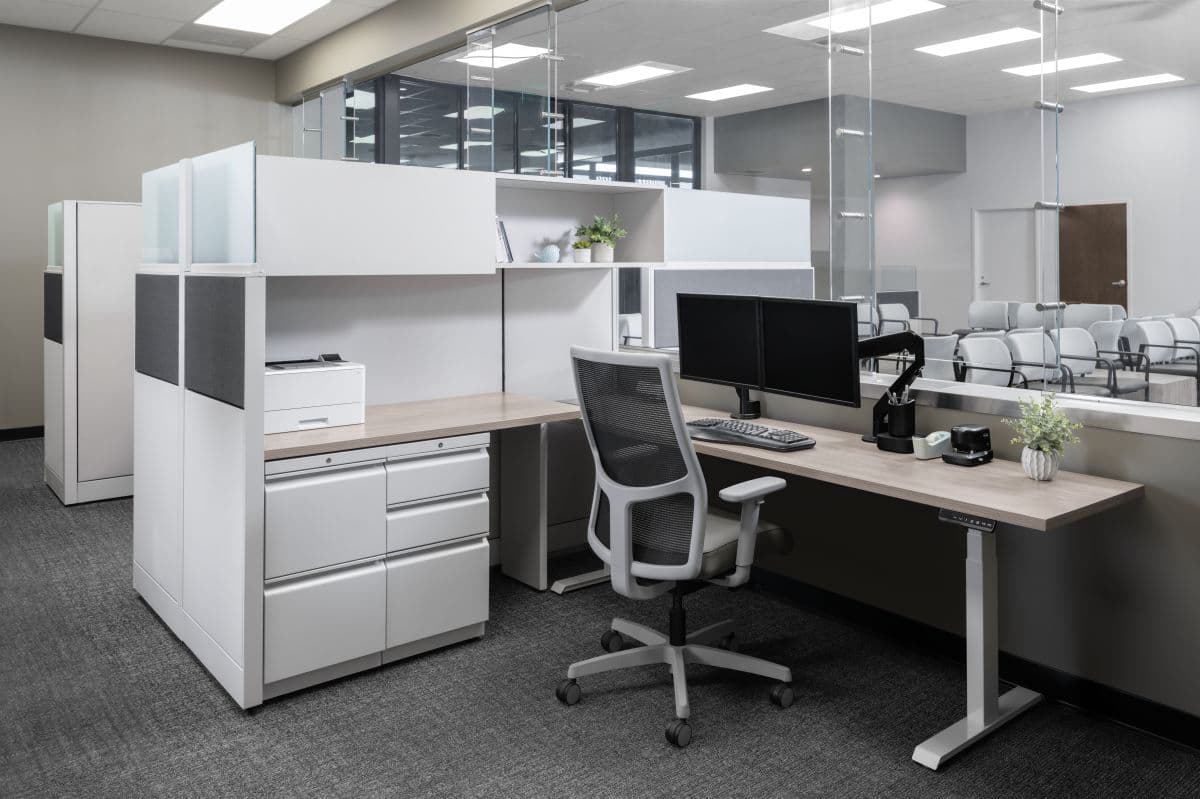
Government & Public Sector Furniture Buying Guide
Government furniture procurement operates within a framework of regulations, compliance requirements, and public accountability that doesn't exist in the private sector. From GSA schedules and cooperative contracts to TAA compliance and the Buy American Act, the process is more structured — but it doesn't have to be more difficult. This 13-step guide walks you through each phase of government furniture buying.
Last updated: March 2026
Step 1: Define Scope and Agency Requirements
Government furniture projects range from standard office environments to highly specialized spaces like council chambers, courtrooms, secure facilities, and public service counters. Begin by documenting the specific space types, headcount, security classification levels, and any agency-specific standards that apply. Federal agencies often have internal furniture standards maintained by their facilities division — request these before any product selection begins.
Engage stakeholders early: facilities managers, IT (for power and data integration), security officers (for sensitive compartmented spaces), and end users. Government projects that skip stakeholder engagement in the planning phase almost always face change orders and delays later.
Step 2: Establish Budget Within Appropriations
Government furniture budgets are tied to appropriations cycles, capital improvement plans, or specific project funding. Understand your fiscal year constraints — obligating funds before the end of a fiscal year is a common driver of government furniture purchases. Budget should include product, delivery, installation, prevailing wage labor (if applicable), and any required compliance documentation or testing.
Step 3: Determine Procurement Vehicle
Government agencies have several procurement options, each with different rules and timelines:
- GSA Schedule (MAS) — The General Services Administration Multiple Award Schedule offers pre-negotiated pricing from thousands of manufacturers. Federal agencies can purchase directly; state and local agencies can access GSA through cooperative purchasing agreements in many states.
- Cooperative Contracts — Programs like Sourcewell, OMNIA Partners, and TIPS offer competitively bid contracts that satisfy most public procurement requirements. These are especially popular with state, county, and municipal agencies.
- Formal RFP/IFB — For large projects or when cooperative contracts don't cover the needed products, a formal Request for Proposal or Invitation for Bid may be required. This process can take 60-120 days from publication to award.
- Sole Source — Permitted in limited circumstances, such as when matching existing furniture or when only one manufacturer can meet a specific technical requirement. Requires documented justification.
Step 4: Select a Dealer with Government Experience
Your furniture dealer must understand government procurement processes, prevailing wage requirements, and the documentation standards expected by public agencies. Look for dealers who hold GSA contracts, have experience with your specific type of agency, and can provide the compliance documentation your contracting officer will require. Ask for references from similar government projects.
Step 5: Compliance — TAA, Buy American, and FISMA
Federal furniture purchases through GSA must comply with the Trade Agreements Act (TAA), which restricts the country of origin for products sold to the federal government. This means many products manufactured in China are not TAA-compliant and cannot be sold on GSA schedules. Verify TAA compliance for every product specified. The Buy American Act applies to direct federal purchases and requires that products be manufactured in the United States or designated countries.
For agencies subject to FISMA (Federal Information Security Management Act), furniture in secure spaces may need to accommodate specific access control, surveillance, and information security requirements. Workstations in SCIFs (Sensitive Compartmented Information Facilities) have additional constraints around sight lines, cable management, and physical security.
Step 6: Space Planning for Government Environments
Government space planning must comply with ADA requirements, GSA space allocation standards (if federal), and any agency-specific guidelines. Public-facing spaces like service counters and council chambers require careful attention to accessibility, including wheelchair-accessible service positions, hearing loop compatibility, and clear sight lines. Courtrooms and legislative chambers often require custom millwork combined with standard commercial furniture.
Step 7: Product Selection — Standard Office and Workstations
For standard government office environments, product selection follows the same principles as corporate furniture — ergonomic seating, functional workstations, and conference furniture. However, government agencies often have standardized furniture programs that limit selections to pre-approved manufacturers and product lines. This simplifies specification but requires working within those constraints. Major manufacturers like Steelcase, Herman Miller, Haworth, and Knoll all hold GSA contracts.
Step 8: Product Selection — Specialized Government Spaces
Specialized spaces require specialized furniture. Council chambers need dais furniture with integrated microphones, voting systems, and power. Courtrooms require judge's benches, jury boxes, witness stands, and gallery seating that meet specific security and protocol requirements. Public service counters need transaction tops at accessible heights, secure storage, and durable surfaces that withstand constant public interaction.
Step 9: Documentation and Audit Trail
Government procurement requires meticulous documentation. Maintain a complete record of the procurement vehicle used, competitive pricing analysis, product specifications, compliance certifications (TAA, BIFMA, GREENGUARD), contract numbers, purchase orders, delivery receipts, and installation sign-off. This audit trail protects the agency in the event of a procurement review or public records request.
Step 10: Review Pricing Against Contract Rates
When purchasing through GSA or cooperative contracts, verify that quoted pricing matches or is below contracted rates. GSA pricing includes a Price Reductions Clause that ensures the government receives the contractor's best pricing. For large projects, negotiate additional volume discounts beyond the contract price — this is permitted and expected on substantial orders.
Step 11: Manage Lead Times and Fiscal Year Deadlines
Government furniture projects often face dual deadlines: fiscal year fund expiration and project completion dates. Standard lead times of 8 to 14 weeks apply, plus additional time for procurement processing. Map your timeline backward from the required delivery date to determine when the procurement process must begin. For complex RFPs, start 6-9 months before you need furniture installed.
Step 12: Installation in Government Facilities
Government building access can be complex. Installation crews may need to pass security clearance checks, carry government-issued ID badges, and work within strict hours. Coordinate with building security and facilities management well in advance. In secure facilities, all packaging materials and tools must be accounted for — nothing can be left behind. Installation teams should expect security escorts in classified areas.
Step 13: Acceptance, Asset Tagging, and Ongoing Management
Government agencies typically require formal acceptance of furniture deliveries, including asset tagging for inventory tracking. Every piece of furniture becomes a line item in the agency's property management system. Conduct a thorough walkthrough and punch list process, then complete the formal acceptance documentation. Establish a warranty tracking system — government furniture often has extended warranty terms that agencies fail to utilize because records are lost during staff turnover.
Procuring furniture for a government agency?
Austin and his team of specialists have deep experience with GSA schedules, cooperative contracts, and public sector procurement. Tell us about your project.
Get Started →